The Ecological Ethic
Co-authored with Peyton Robertson
OPHI25: Advanced Topics in Philosophy: The Nature of Tomorrow
November 13, 2019
I. Introduction
In this paper, we will present a ‘weighted sum model’ which captures many values not easily accounted for by existing modes of environmental valuation, creating an ecosystem of values that becomes the basis for the ecological ethic. The ecological ethic incentivizes preservation of the environment not through appeals to human-dominated moral standards but through the more capitalist-palatable concept of value growth, while taking seriously the considerations of non-human agents. Such a valuation is compatible with a Kantian ethics in which not only rational beings, but also all plants and animals are valued as ends-in-themselves. Yet the ethic allows for practical calculations that take into account the values of each agent involved, regardless of species, when deciding between competing actions. While allowing for ‘infinite growth’ of value, our method differs from a ‘zero-sum’ capitalist worldview in that it offers an incentive for people to behave ethically towards the environment, as preserving and protecting the environment augments its value to humans and other species. We will 1) define ‘value,’ 2) present the valuation calculation as a weighted sum of agents’ values, 3) highlight the merits and concerns for the complex interrelations that would arise from such a system, including the implicit incorporation of external sources of value — ranging from the historical to the aesthetic and 4) discuss the potential for an environmental ethics based on such a value ecology.
II. Defining and Justifying ‘Value’
We start by clarifying the notion of ‘value.’ An ‘object’ is the entity that is valued; ‘agents’ are the entities that value the object. Stated in simplest terms, to value an object is to derive some benefit or use from it or to believe that it generates some benefit or use. Generally, valuing an object entails wanting to preserve or prolong its existence. This definition has a few implications for how value works: first, an agent can value anything as long as she thinks it has some use. For example, one might suggest that a child’s imaginary friend is useless, but the imaginary friend can serve a function for the child, implying that the child is capable of valuing it. Second, an agent cannot value something if she thinks it does not have any use — if the child stops deriving any benefit from her imaginary friend and would not care if it were to stop existing, the child no longer values it. Third, an agent can value something that does not have any direct use to them — a child who no longer needs her own imaginary friend may still attest to the benefits of having one, and can still be said to value imaginary friends because she believes that they are useful. Fourth, and most importantly, the first part of this definition of value allows for agents that are not rational or self-aware. A damselfish can be said to value a coral reef because it derives the benefit of shelter from it; an aspen tree can be said to value soil because it derives the benefit of nutrients from it. Defining value in this way enables us to avoid asserting an ‘objective’ notion of what is valuable as imposed by a human-dominated hierarchy of needs. Rather, the system we propose suggests that value is interconnected with what other agents value — each contribution to the sum is necessarily entangled with all other contributions.
One aspect of value that must be mentioned is price. Capitalism insists that everything be valued, and suggests that value is “what the market is prepared to pay” for an object (Williams 1). But when we assume that something is ‘priceless,’ we implicitly assign it a value of 0 (Williams 7). Under such a system, sources of value such as aesthetic, historical, or therapeutic worth — which can be captured in our definition of value — must be translated into dollar terms, or they are simply unaccounted for. Because these qualities are often discounted or excluded from the monetary price of an object, the capitalist system of assigning value in terms of dollars tends to undervalue objects (Williams 3). A conservative estimate of the value of the Sherbrooke Forest in Australia adds up to $759 million, which still fails to fully capture the benefits to humans, plants, and animals in the short and long-run that come from preserving a carbon sink filled with diverse flora and fauna (Williams 20). Many of the benefits derived from the forest — reasons humans value the forest — are dependent upon other values: humans value scientific discovery, and as part of science we value the preservation of biodiversity, which leads us to value each of the species in the forest; the species in the forest value certain environmental conditions that make their survival possible, and because we value the survival of those species we must also value the preservation of the environment. In such webs of deeply intertwined needs and preferences, it is unclear how a dollar-based system selects a price that would reflect the true value of the object. In fact, Naomi Klein argues that some environmental concerns are fundamentally incompatible with capitalist values. For example, climate change disproportionately affects communities living near the equator — some of the poorest nations on Earth which contribute less economic value (Klein 49). A dollar-based system is useful for identifying the values of individuals, but often fails to equally weigh the values of communities. Thus it cannot capture the stakes of climate change, as well as other cases of collective harm in which most agents feel an insignificant individual financial burden for hurting undervalued communities.
III. The Weighted Sum System
We next establish axioms for our quantitative notion of ‘value.’ In order to effectively decide what action to take in cases where values conflict, we insist that values be a well-ordered quantity; that is, one in which we can impose an order relation >, abbreviating X is more valuable than Y. This relation should be reflexive (all identical objects have the same value) and transitive (if X > Y and Y > Z, then X > Z). Thus it is natural to let values be real numbers, and ‘>’ denote the standard ‘greater than’ ordering. In a complex, interrelated system like the environment (quite literally, an ecosystem), it is essential that any valuation take into account the concerns of every living being. Put formally, if X is valued by both A and B, while Y is only valued by A, X should have more value than Y. Thus, total value as a ‘sum’ of individual values seems appropriate, as each individual’s value of an object will increase the overall valuation.
A summation of individual values effectively captures the magnitude to which an object is valued. The planet ostensibly is valued by all of its inhabitants, both living and nonliving, which by summation would make it the most valuable physical object. This notion may begin to provide a basis for environmental preservation — “out of value [...] we derive duty” (Rolston 2). However, a system that simply sums the number of agents that value an object leads to value judgements that may be viewed as inaccurate or unacceptable — it implies that humans should value the objects that bacteria value just because there are more bacteria who value those objects. To define the weights of agents by species is also a problematic approach: attempts to determine the weight assigned to each species typically devolve into suggestions of weight based on how useful a species is to humans. We are more likely to prioritize the values of our livestock, which provide consumers with food and farmers with a livelihood, over the values of a parrotfish or platypus. This result is “self-defeating, because it is [...] focused on the level of the component, rather than the level of the whole” — the method unjustifiably generates a human-centric system of values (Partridge 5). Further, both the simple sum and the weighted sum based on species fail to allow for variation in the weighting of individual agents’ values within a species. Yet, most would agree that we should allot more weight to the values of an ordinary, young person over the values of a psychopath, or of a grandmother on her deathbed. A successful approach to differentially weighting agents must take into account the degree to which others value agents, without imposing a hegemony of the ‘most valuable’ agents.
We propose a method of weighting that treats individual ‘agents’ as ‘objects’ in themselves. We start by calculating the value of each agent (henceforth referred to as agent-object), as determined by the sum of agents that value the agent-object. The agent-objects that are valued most are given more weight in the calculation of the value of the object. Attributing more weight to agent-objects that are valued more is an intuitive approach: a simple example of this may be a case where agents A, B, and C are all given a value of ‘1’ while agent Z has a value of ‘5’ — if A, B, and C value object X (conferring a value of ‘3’) but Z values object Y (conferring a value of ‘5’), then Y will be more valuable than X. But note that Z’s ‘5’ value must result from other agents who value Z external to this small system — even if A,B, and C all value Z, they can collectively confer at most a value of ‘3,’ and thus never ‘overrule’ what they value directly (X) with what is valued indirectly (Z). This result is consistent with our ethical intuitions — consider a (rare) species that benefits from humans, like dogs. Dogs value humans, but value towards this agent-object does nullify their values towards objects like the Earth. An agent who values an agent-object is not subjugated to the values of the agent-object.
By valuing objects because other agents, whom we value, also value them, the object’s value emerges from the interrelated concerns of the collective. As an example, we (agents) value the fish we eat (agent-objects) which depend upon healthy coral reefs as habitats, meaning that humans can contribute to the value of coral reefs (the object) by increasing the value of the fish — even if humans do not directly value coral reefs. (Of course many humans do value coral reefs for reasons such as their aesthetic or scientific contributions, further increasing its value.) By weighting every human and fish that values coral reefs as an agent-object of its own, the coral reefs increase in value as the agent-objects that value them become more valued themselves. And increased value of reefs will cause the reefs to value those who protect the reefs -- increasing the value of the agent-objects, and the reefs themselves in turn. The weighted-sum model constructs an ‘ecosystem’ based on codependent, mutually-reinforcing values (Figure 1).
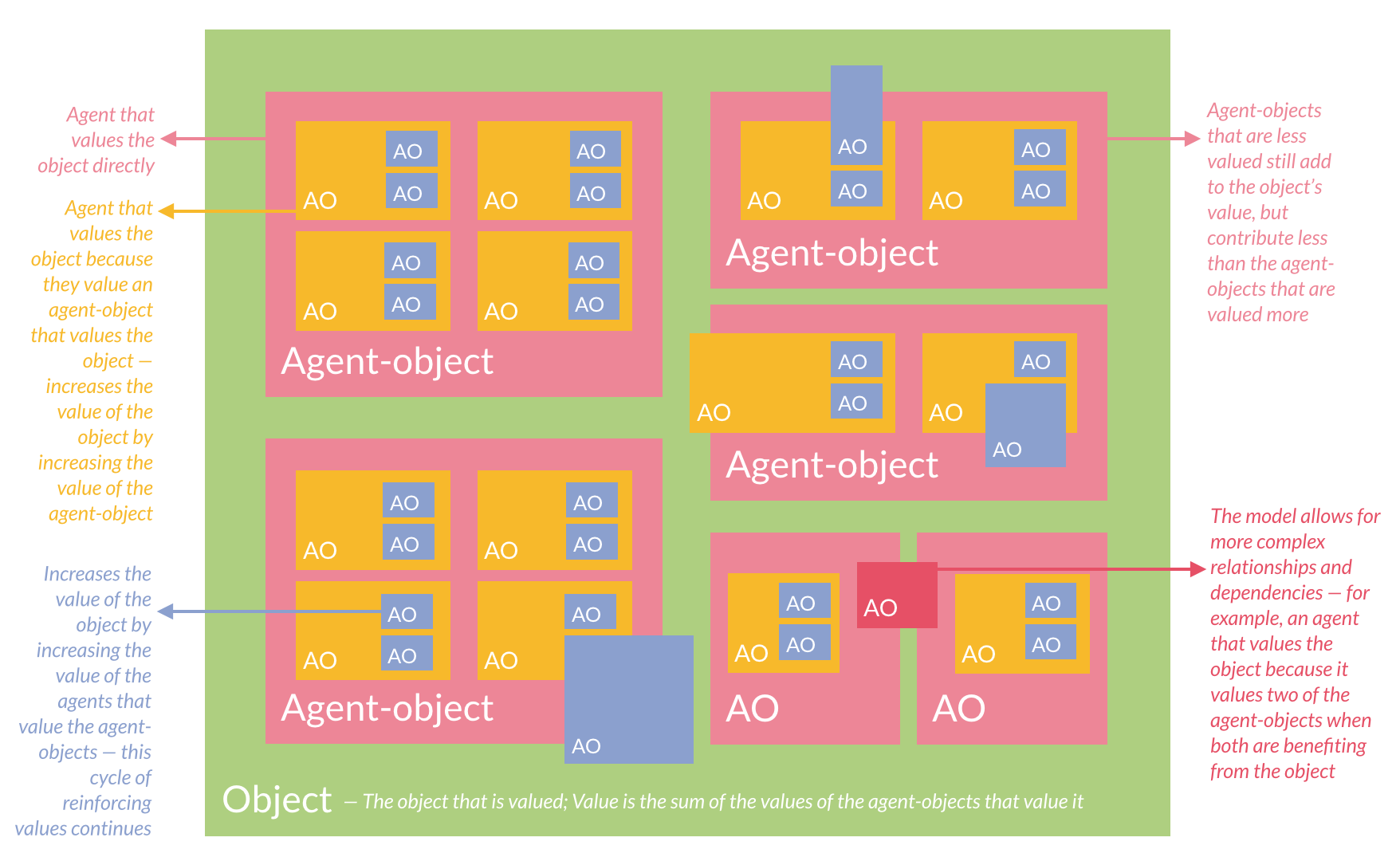
Figure 1
IV. The Ecological Ethic
The capitalist valuation system suggests that value can grow ad infinitum from the production of more stuff — especially objects that are easy to produce rapidly and thus not attributed as much value by agents, such as clothing (at the expense of broader sources of value, like the Earth). In contrast, the weighted sum system suggests that value can grow through investments in the value of objects that already exist. To return to the coral reef example, humans can invest in the protection of coral reefs by creating Marine Protected Areas that limit human activities in reef areas. With healthier coral reefs, the fish that rely on the habitat will be able to grow larger and reproduce more — and a larger number of healthy fish are more valuable to humans than a smaller number of underdeveloped fish. Not only would they ensure healthier fish, but also stronger coral reefs would confer additional benefits by assisting with nutrient recycling — the initial investment in their conservation makes them more valuable. The ecological ethic presents a model for how humans should treat the environment that, like capitalism, is based on growth — but the growth is achieved by augmenting value rather than ‘creating’ it.
One might object that this ethic creates an infinite regress of value such that the notion of value becomes meaningless. But instead it creates an incentive of growth if we choose to value each other; everything doesn’t become infinitely valuable immediately, but rather gains value over time if we look to expand our network of values. In Marxist theory, it is said that “capitalism is an abstract capitalist” — taking actions to encourage its own growth and perpetuation (Wolff). Similarly, by offering the incentive of growth, the ecological ethic becomes a sort of agent-object in itself. By valuing the ethic, and working to expand her network of values, agents can increase all of their values. This mindset is, in fact, well-suited to modernity which is preoccupied with a concern for ‘growth’ in everything from metropolises to clicker video games.
V. Compatibility
The weighted sum system lends itself to an ecological ethic that is compatible with existing ethical models. The Kantian “Formula of Autonomy” that “the will is not merely subject to the law, but also [makes] the law” is essential: otherwise we are manipulated by the desires of others (Kant 537). In moving from desires that arise from within ourselves to an ecology of values, we realize something akin to Kant’s “kingdom of ends”: a hypothetical society in which our valuations could be agreed by all as common law (Kant 538). Of course, Kant’s formulation was slightly different: that our ‘reasons’ for acting could be ‘rationally’ agreed upon as common law. Our shift from ‘reason’ to ‘valuation’ reflects the inclusion of non-human animals and even plants and other organisms regardless of their capabilities for ‘reason’ and ‘rationality.’
From the ecological ethic, many sources of environmental value that Rolston describes naturally emerge. For example, consider dialectal value — the value of tension between opposites, such as suffering and happiness. “The hardest lesson in ethics is to learn to love one’s enemies” — agent interests that are aligned with the interests of others will be amplified by the ecological ethic, but what about when interests clash (Rolston 23)? Is there a value to things being ‘in balance’ that must be incorporated into our value-sum? Similarly, how should we assess historical value, scientific value, or cultural-symbolization value? While these are legitimate ‘classifications’ of value, the project of incorporating these as additional terms in our weighted sum would be challenging, subjective, and human-centric. A post-capitalist environmental ethicist must agree that this question is not hers to decide — but rather ours to decide. Inside each person we have a sense of what is valuable, and if we value this balance — both in our values of objects and agent-objects, then it will emerge in the final sum.
Works Cited
Kant, Immanuel. “Groundwork of the Metaphysics of Morals.” Translated by H.J. Paton. Introduction to Philosophy 7th ed., , edited by John Perry et al. Oxford University Press 2016.
Klein, Naomi. This Changes Everything: Capitalism vs. the Climate. 2014.
Partridge, Ernest. “The Philosophical Foundations of Aldo Leopold’s ‘Land Ethic’.”
Rolston, Holmes. “Humans Valuing the Natural Environment.”
Williams, Karl. “Measuring The Value of a Tree”. https://www.earthsharing.org.au/2006/09/how-do-you-value-a-tree/.
Wolff, Robert Paul. “Marx Lecture 2.” https://www.youtube.com/watch?v=Jiep5AYcsoA.