4 Days in Florence
Refreshed thanks to our magical retreat in the Tuscan countryside, it was time for us to head to the city. When planning this trip, I was secretly most excited for our time in Florence. The art! The food! The ability to walk everywhere instead of hunting down taxis like in Rome! When my mom and I visited Italy in 2016, we only had a day to visit both Florence and Pisa, which meant that we only had time to hear about the wonders within each building while standing outside or from afar. The only solid memory I had of Florence was that we’d had the best pistachio gelato to ever grace our tastebuds. After this trip, Florence truly cemented itself as one of my favorite cities in the world.
While Florence is very walkable, we’re still glad that we opted to stay in the center of the city at the art deco-inspired Hotel Calimala. The Duomo / Cathedral of Santa Maria del Fiore complex and Uffizi Gallery were both within a five-minute walking distance from our hotel. Since each building of the Duomo complex has a different entrance line, our proximity made it easy to drop by when lines were shorter.
Day 1: Driving through Chianti, Arriving in Florence
Driving directly from Il Borro to Florence theoretically takes less than an hour, but we are a family of maximizers who will never squander an opportunity to see more things. We got lucky (again!) with the weather, so my dad planned a new route that took us through notable towns in the Chianti wine region: Radda, Panzano, and Greve. Compared to the swaths of rolling hills we’d seen in the days before, the Chianti region is mountainous, evoking ‘majestic’ more so than ‘enchanting.’ We cruised up, down, and around hills and valleys dotted with grapevines and olive trees. The whole way, we were tempted by billboards advertising walk-in wine tastings.
All three towns boast well-preserved medieval architecture, and Greve hosts the annual Chianti Classico Wine Festival, a celebration of the region's winemaking tradition and cultural heritage.


We arrived in Florence just around sunset. While my dad handled the stress of driving through narrow alleys to drop off our rental car, the three of us girls strolled from the hotel to the Duomo complex. It’s a sight to behold up close. I hadn’t expected to feel emotional seeing the Cathedral of Santa Maria del Fiore again, but it’s such a striking work of architecture. In photos, I feel like it always comes across as black and white, but the exterior is actually decorated with white, green, and pink marble.
Our first order of business was not to examine the architecture: we scurried into in the line to climb the bell tower, only to realize there was a second line to buy tickets. We divided and conquered, but found that the only time slots left that day were well past sunset, so we bought tickets for the next day instead. After much debate over which slot would be best for catching the city at golden hour, we settled upon a 3:45pm entry to account for the time required to climb.
With those logistics settled, we treated ourselves to some gelato at La Strega Nocciola Gelateria Artigianale. The shop’s gelato was stored in covered tins — a sign of authenticity, as this indicates the gelato is being kept at its ideal temperature. Every customer emerged with a white scoop, and a quick hunt through Google reviews suggested that this was likely the ‘buentalenti’ flavor (featuring simply milk, cream, sugar, and eggs), named after Bernardo Buontalenti, the Florentine inventor of gelato. Since it was the end of the day, many of their other flavors had sold out, but we were nevertheless excited to try it. ‘Buentalenti’ was sweeter than expected, and I ultimately preferred their namesake flavor (nocciola, aka hazelnut). My mom got their yogurt flavor and loved it.
We entrusted Beli with identifying a dinner spot near our hotel: Ristorante Hostaria il Desco. Beli has never let me down. It predicted I would give the restaurant a 9.2, and the average of our ratings that night ended up being… 9.2.
You’d think a restaurant so close to all of Florence’s major attractions would be a tourist trap, but Hostaria il Desco is just slightly off the beaten path in a quieter alleyway. It’s a lovely environment with reasonably-priced Tuscan cuisine. I tried Florentine ‘bread soup,’ which was definitely more bread than soup, but it ended up being surprisingly addictive because the tomato flavor was so fresh. The best dish of the night was the beef fillet with truffle; the sauce paired incredibly with the fillet, making an almost creamy, indulgent flavor. We weren’t terribly impressed by the desserts; the panna cotta was a bit too rich for us to finish and the tiramisu was more creamy than coffee-flavored — a trend we noticed throughout Tuscany.
Day 2: Uffizi Gallery, Galleria dell’Accademia, Duomo (Giotto’s Bell Tower)
Our second day in Florence was definitely one of the highlights of the whole trip. In the morning, we headed straight to the Uffizi Gallery, one of the world’s most overwhelmingly extraordinary collections of Renaissance masterpieces.
In preparation, I used ChatGPT to compose a study guide of the top 10 masterpieces, top 10 underrated pieces, and themes a visitor should look for in the galleries. In my prompt, I also asked for a couple of discussion questions about each of the listed artworks. This impromptu study guide was actually very helpful for me because when looking at older artworks, it’s easy to forget that these masterpieces were revolutionary for their time period. Viewing art from our current context, when we’ve already seen the developments in techniques and styles that followed from the Old Masters, from incredible realism to whimsical abstraction, we fail to appreciate how artists had to build these new artistic vocabularies over time. Throughout history, artists have expanded our collective scopes of expression and imagination by depicting new subjects, exploring new poses and lighting, and using new materials.
For example, thanks to ChatGPT, I learned that in The Ognissanti Madonna by Giotto di Bondone (c. 1310), the spatial depth created by the positioning of the figures was an innovative approach to perspective. Michelangelo’s Doni Tondo (c. 1504-1506) alludes to his structural approach to painting and mastery of anatomy (note the super muscular Christ Child). Rather than adhering to traditional, idealized representations of mythological figures, Caravaggio used a real model to depict Medusa (c. 1597). These are all details that I would otherwise never have known or appreciated.
Since I can’t go in depth about every artwork (and while those facts were easily Google-searchable, I’m wary about quoting ChatGPT with no ability to cite sources), here is a refined version of the list of themes to consider while you’re close looking at the Uffizi:
Evolution of religious art. How did artists depict Biblical stories and religious figures over time? What changes in style, symbolism, and narrative do you see?
Portraiture through the ages. What changing conventions do you see in subjects, facial expressions, and poses? For example, Baroque art is stylized by intense lighting, dynamic compositions, and heightened emotions.
Mythological narratives and impact of classical antiquity. How were mythological themes interpreted by artists in different periods? How did ‘newer’ artists draw inspiration from and revive classical themes and ideals?
Allegories, symbolism, and iconography. How do artists convey allegorical messages and moral lessons? How did artists interact with the religious, political, or personal circumstances of their time? Can these works provide insights into the beliefs or attitudes of the artists or their patrons?
Landscape painting in the Renaissance. Notice the shift from using landscapes as background settings to creating works that celebrate the beauty of nature in itself.
Scientific influences. Consider the influence of scientific discoveries and new technologies on art — both in subject, and in the evolution of artistic techniques and materials, such as the development of oil painting during the Renaissance.
Even before we ascended the stairs to their main floor, I was blown away by their temporary exhibitions. They had an exhibition on influential journals published in Italy in the early 1900s, which included the explosion of futurism, the artistic and social movement which celebrated modernity, technology, speed, and a break from traditional values. In my favorite high school English class, Modernist Literature and Photography (affectionately known as ‘ULit’), we learned about futurism and analyzed Marinetti’s manifesto as well as Balla’s and Boccioni’s paintings, so the movement has a special place in my heart. I even have a tag in my online art collection dedicated to works that remind me of the class.
The main collection is dizzying in volume and quality. I had, of course, heard of Botticelli’s The Birth of Venus (c. 1484-1486) and Spring (c. 1480), but coming face-to-face with them was something else entirely. Both works were larger than I expected, and each canvas contains an astonishing level of detail. Spring, for example, features at least 138 different real, accurately-portrayed plant species. The sheer gowns; the iconic, elegant face of his model, Simonetta Vespucci; the poses that add a dynamic quality to his work… I felt like I could stare at it forever and there would always be some exquisite detail to admire. I admit I was teary-eyed!
The Uffizi has numerous other works by Botticelli, all of them truly lovely. Of his ‘less famous’ works, I particularly liked Adoration of the Child with Angels (Madonna of the Roses). For a scene that has been done a million times and a million ways by artists over the centuries, this painting stands out to me because… well, it’s pretty. It reminded me that I can like a piece of art simply because I find it beautiful. Sometimes, there’s no need to intellectualize. Most art in museums is presented with context that deems it ‘interesting,’ but the aesthetic pleasure of the art is more than sufficient for making it worthy of attention.
In addition to my immediate allegiance to the Botticelli fan club, I found a new favorite artist in Filippo Lippi, whose works also feature delicate, thin strokes (unsurprisingly: Lippi was Botticelli’s teacher). Another cool section of the museum was their extensive collection of artist self-portraits. It was so interesting to see how artists portrayed themselves and to be able to recognize some of them immediately due to their distinctive styles — for example, Marc Chagall’s vivid colors popped off the wall. I could go on and on about the works I wish I had time to examine more closely, but all you really need to know is: the Uffizi is a must-see.


We did need a break from the hours of walking, so we headed to Perché no…!, the very same gelato store that had engraved itself within my mom and I’s memories seven years ago. Luckily, we’ve always been ardent documenters and had taken photos of our gelato cups back then, so it was easy to look up. The shop was conveniently located a two-minute walk from our hotel (coincidence? Not at all). The pistachio was as impossibly nutty and fresh as we remembered, so I can confidently say that this is our favorite gelato in the world. I’m drooling just thinking about it.
From there, we headed to the Galleria dell’Accademia to see our friend David (of Michelangelo). To be honest, after seeing the intricate designs of Bernini in Rome, he wasn’t really to my taste. Nevertheless, I can appreciate Michelangelo’s vision and technical mastery for carving his detailed figure out of a single block of marble — and the cultural legacy of the piece (the Biblical story of David and Goliath, which focuses on cleverness and intellect, aligned with key values of the Renaissance). I found my personal favorite sculpture in Florence in a room covered floor-to-ceiling with plaster casts: Luigi Pampaloni’s Reclining girl. Have you ever seen a more serene sleeper? She’s living my dream! Other treasures at the Accademia include lots of impressive religious art, such as Pacino di Bonaguida’s Tree of Life, depicting episodes from Christ’s life, and a small museum of musical instruments.
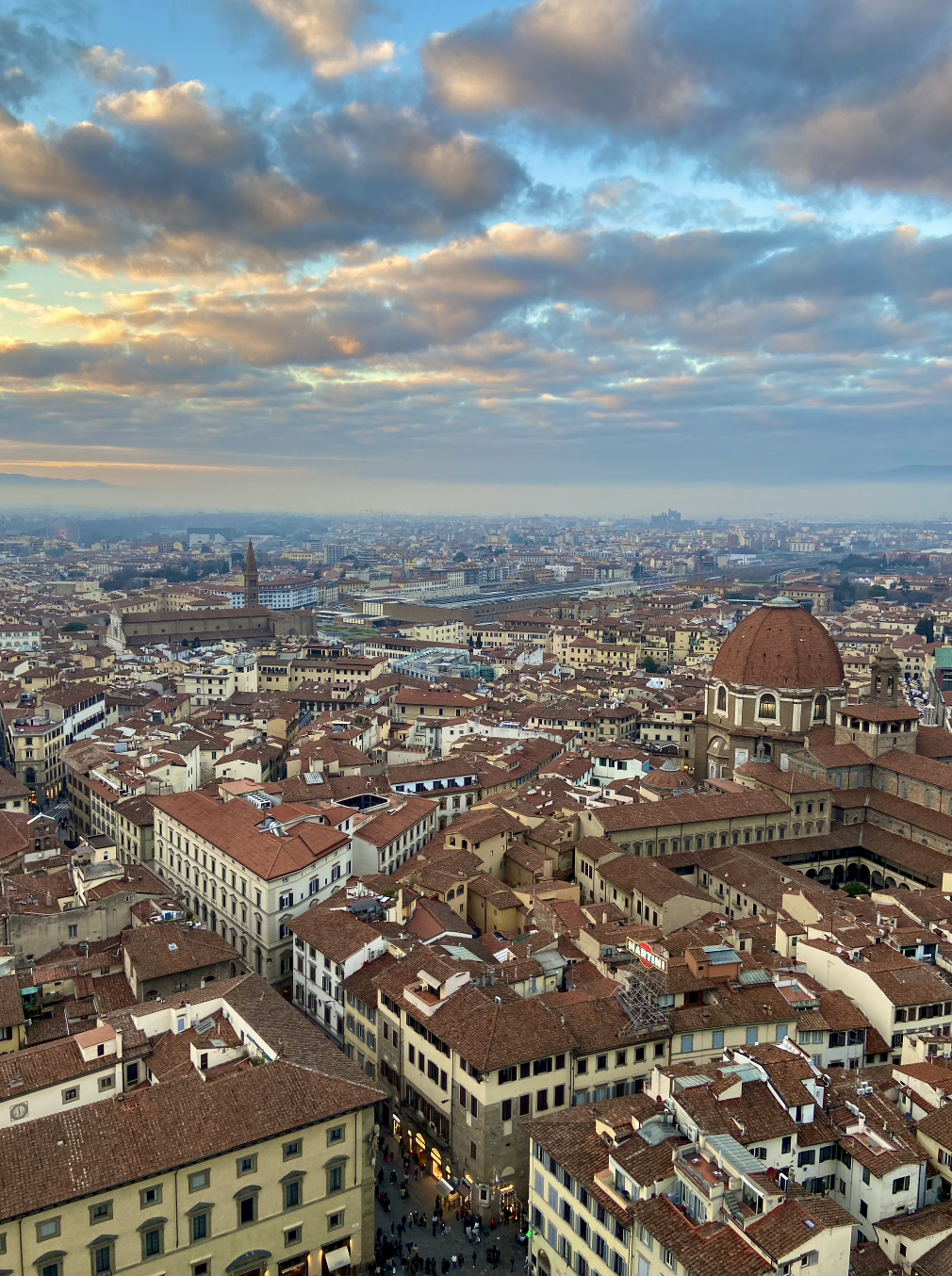
Feet already aching from the two art museums, we trudged over to line up at Giotto’s Bell Tower in the Duomo complex. It had been cloudy all day, but as our clocks ticked closer and closer to our 3:45pm entry time, the sky started to open up with patches of blue. The bell tower has 414 steps and there are five levels for resting and taking photos. We marched up the stairs, determined to make it to the top before sunset. With each new level we reached, the lighting upon the buildings below us shifted from flat daylight to a radiant golden glow. At the top, we enjoyed the view of the Cathedral’s dome (also climbable if you’re interested) and the sprawling city. Florence is large but orderly. Everywhere we looked, we could see red tile rooftops and elegant, curving streets centered around plazas filled with people and life. A bit of fog around the mountains hung around the city, reminding us that we were still in Tuscany; those enchanting rolling hills and mountains were just an hour-long drive away.
By the time we reached the bottom, the sun had set and the magical lighting was gone. It never returned; our last two days in Florence were cloudy and gray. How incredible is it that the one hour in Florence we wanted good lighting, we received it? What if we’d picked a different timeslot when buying our tickets the day before? Serendipitous!!


We took a break at our hotel before heading out to dinner at Nugolo. Not to be dramatic, but this particular dinner was one of my biggest dilemmas when planning the whole trip (and the origin of our tourist-trap-to-pretentious evaluation scheme, explained in my Rome blog). One of the reasons I was most excited for Florence was the food scene. Between my friends’ recommendations from their time studying abroad and other online recommendations, it seemed like there was no shortage of dazzling culinary experiences, and I didn’t want to waste a single meal. For Day 2, I was able to snag reservations at both Nugolo and La Giostra. Based on one-star reviews, people who didn’t like Nugolo thought it was pretentious, and people who didn’t like La Giostra thought it was a tourist trap — so I went with my gut, which told me that we’ve historically leaned ‘pretentious.’ La Giostra is also open for lunch, so I knew that if we really wanted to try both, we could still visit La Giostra on our last day. While we never ended up visiting the home of pear ravioli, I have no regrets because Nugolo was fantastic. Dare I say a hidden gem? The quality of food they’re serving far exceeds the €60 per person price point of their five-course tasting menu.
We opted to order a la carte to try more dishes. Every single dish was beautifully presented and the flavors were unique. One of the standouts of the night was their Egg 64 appetizer. It’s described as containing potato foam, turnip, apple, and lumpfish roe on the menu, but texturally it was like a foam-ified 鸡蛋羹 (Chinese steamed egg custard) or foam-ified mashed potato. Our favorite dish was the cod loin, served with baked leeks and an amazing roasted onion broth. That broth was like a panacea. If I could drink it as a daily beverage, I think I’d ascend to some higher plane of existence and wellness. The cod itself was so tender and topped with a smoky cream that meant every bite absolutely melted in our mouths. The meal ended cheerily with a limoncello shot, a classic Italian digestif.
One unexpected reason I’m glad we opted for Nugolo was that it was outside the tourist center of Florence. While only a twenty minute walk from our hotel, on the way there and back we got to see non-touristy shops and bars where people were singing and dancing all night — the chatter of Italian, not English, filling the air was a welcome change.
I think about the hours I agonized over this dinner decision, reading through pages upon pages of reviews to discern the ‘right’ choice. In retrospect, La Giostra likely would have been good as well, and at worst, having a tourist trap meal wouldn’t really detract from our travel experience. For every decision we make, we can never know how things would have turned out if we’d chosen differently. Is my crazed research justifiable, or a waste of time? Why do I care so much about where we eat? I’ll answer that juicy question after Day 3.
Day 3: Ponte Vecchio, Piazzale Michelangelo, Saporium, Pitti Palace
Day 3 was a slower day, defined simply by two of my most-anticipated restaurant reservations: lunch at Saporium and dinner at Vini e Vecchi Sapori. Before walking to lunch, we visited Ponte Vecchio and Piazzale Michelangelo to check off those tourist boxes. The bridge will always be crowded, but the plaza is definitely worth a visit for one of the best views of Florence. Saporium is only a short walk from the stairs leading up to the plaza.
Saporium, opened in 2023 and already awarded one Michelin Star as well as the Green Star designation for restaurants at the forefront of the industry for sustainable practices, is a pet project of the Borgo Santo Pietro resort in Tuscany. For lunch, they offer several 8-course tasting menu options (meat, fish, vegetarian) all priced at €170 per person as well as several shorter/a la carte options. This is fairly standard pricing for a Michelin-starred restaurant, especially for a menu with so many courses, but it felt like we were robbing them. Ladies and gentlemen, this was the best meal of our entire lives.
I don’t say that lightly. We are at a point with fine dining where we’re rarely impressed — maybe delighted or satisfied, but our favorite restaurants feel hard to beat. After the hors d'oeuvres, Saporium had already earned a place in our top 10, but by the end of the meal, it was undoubtedly our collective #1. The service was impeccable and each dish was explained in depth with a focus on seed-to-table ingredients from their own farms and local supply chains. The dining environment was gorgeous, with lush seating and a window to peek into the kitchen, and the presentation of every single dish was phenomenal. One of the desserts, the Medici Rose, was a work of art. The rose dessert starts out sitting in a pool of milk, and the server pours Officina Profumo-Farmaceutica Santa Maria Novella’s Alkermes liqueur inside, creating a kaleidoscopic firework of pink and red. Even the angel’s hair-thin breadsticks became a table centerpiece (and don’t be deceived by their size. Skinny sticks, big flavor).
We each ordered a different tasting menu to sample all their dishes, and every single thing tasted good. I say ‘good’ because some fine dining is unique and impressive, but fails to create dishes you’d actually want to eat again. Saporium’s flavors are innovative but not remotely pretentious. This is not the kind of taste you have to ‘acquire.’ Every dish was a revelation. Our minds were blown again and again with memorable flavors that literally unfolded on the tongue — a single bite could feel like a journey of several epiphanies.
Saporium hasn’t made waves yet, but we think their current one star is a serious understatement. We’ve had far less enjoyable and far less heartwarming meals with more accolades, at higher price points. Wake up, world!!


Three hours later and feeling like we’d been irrecoverably spoiled, we headed to the Pitti Palace to look at some art not presented on a plate. The Pitti Palace was the primary residence of the Medici family, who ruled Florence and the Tuscany region and bankrolled the Renaissance. Their numerous galleries are covered floor-to-ceiling in Renaissance and Baroque masterpieces, reflecting the Medici wealth and patronage of art. Here, works of Lippi, Raphael, Rubens, Titian, and Caravaggio are crammed in haphazardly. Besides these usual suspects, the palace houses a rotating exhibition of fashion pieces and they have a lovely modern art collection. I was particularly delighted by their collection of Adriano Cecioni sculptures, including a toddler crying while being chased by his rambunctious puppy and a smiling mother carrying her baby. Such works are inelegant compared to grand monuments to deities or heroes, but they felt warm and alive, like the 19th century equivalent of a home video taken on a blurry camcorder.
We walked back to our hotel to rest before our late night dinner reservation at Vini e Vecchi Sapori. They only take phone reservations, so we enlisted the help of our hotel and got a 9:00pm slot. Normally, I’m a 5:00pm dinner kind of girl, but this was the restaurant in Florence that had the highest Beli recommendation score prior to the trip — my most-anticipated meal. I scrolled through pages upon pages of reviews and concluded that the only one-star reviews came from people who had waited and weren’t seated (and thus, had not actually eaten the food). Everyone else gushed about the family-owned, convivial environment; one reviewer said that she ate there during her study abroad program and when she came back years later, they still recognized her.
After Saporium, I was apprehensive. We had to wait outside for about ten minutes after our reservation time to be seated, and while everyone inside looked jolly and plates were licked clean, I felt like anything after our lunch would pale in comparison. I’m glad to say that our experience here put us solidly within the ‘gushing fans’ category. The two restaurants are on opposite ends of the ‘fancy’ spectrum, but no restaurant delivers on warm, Italian hospitality and affordable, feelgood food like Vini e Vecchi Sapori.
Was the food mindblowing? Sort of, in the sense that other restaurants make the same dishes but they somehow taste better here (the secret ingredient must be love). It's a great spot to try Florentine steak or beef fillet, and their handmade duck pappardelle is a must-order. What sets this place apart is its vibe: daily-changing handwritten menu, walls decorated with old photos and placemats doodled on by customers, everyone talking to each other like old friends. At one point, I pointed out their giant salami tube on the counter to my family, and they noticed and cut us a few slices to try. Of course, the meal ends with limoncello for all. They’re the kind of restaurant that rounds down for you on the receipt, even when you’d gladly pay more. Everyone leaves glowing and happy. In the terms of a brilliant food blog I stumbled upon recently, Understanding Hospitality, Vini e Vecchi Sapori provides “an ultimate expression of hospitality, a peak experience that reminds us why life is worth living, a restaurant as warm and genuine as grandma’s house.”
We loved Vini e Vecchi Sapori so much that we actually came back for lunch the next day (this is rare: we are not restaurant repeaters when we travel). This time, we had no reservation and we were entering close to the end of their lunch hours, but they remembered us and squeezed us in. Funnily enough, a couple from Dallas who we’d met at dinner the night before came back as well — it was an unexpectedly delightful reunion for us all. Ciao! Ciao! More duck pappardelle for me!


Our experiences at these different Florentine restaurants bring me back to the question I raised earlier: why is food such an important aspect of travel for me? The three reservations I painstakingly selected in Florence (Nugolo, Saporium, and Vini e Vecchi Sapori) were easily our favorite meals of the whole trip and amongst our all-time best dining experiences. Some meals are simply enjoyable, but each of these three added something to our trip and lives beyond a temporary delight to our tastebuds. They deepened our connection to Florence, and evidently, I keep thinking about these meals long after leaving.
When designing an itinerary, my family often asks: what can we do here that we can’t do anywhere else? What is this place most known for? That could be museums, hiking, touring historical/UNESCO sites, or watching performances (for example, flamenco in Barcelona or ballet in Paris). But wherever we go, there will always be cuisine. Every city and culture takes pride in its food because it’s woven into everyone’s daily lives. Compared to other attractions — a museum no tourist will ever have enough time to thoroughly peruse, a historical site that merits lifelong study to understand — there’s no ‘surface level,’ diluted version of consuming a meal. While I might appreciate a still life with vegetables hanging on a gallery wall, it’s far likelier to fade to the recesses of my memory than a literal plate of delicious vegetables that I’ve tasted. During a meal, you hear the plate sizzling and the nearby conversations, you smell the dish as it’s set down in front of you, you feel its texture on your tongue. The sensory experience becomes forever a part of you. Most travel experiences feel locked in some distant, happy past (there’s no Uffizi in the US!), but food is more persistent. We taste something at home and it reminds us of a certain meal; we try to replicate favorites in our own kitchen; we seek out restaurants from new cuisines we’ve sampled.
Sure, I should find a more efficient way to gauge which restaurants to try during future travels. But given the limited time we have to allocate during any trip, I stand by my efforts to seek out meals that showcase the ‘best’ a destination has to offer, whether we fine dine for hours or squeeze into a busy local favorite — because the best food and travel experiences are permanently additive.
Day 4: Basilica of Santa Croce, Opera del Duomo Museum, Medici Chapel, Mercato Centrale, Officina Profumo - Farmaceutica di Santa Maria Novella, Baptistery of St. John
Our last day in Florence was a blur. We visited the Basilica of Santa Croce in the morning, which houses the tombs of some impressive people: Michelangelo, Machiavelli, Dante, and more. We then decided to make use of our Duomo tickets (while the bell tower entry has a specified time, the tickets for the other buildings were valid for 3 days). To avoid the long lines outside the cathedral, we ended up at the Opera del Duomo Museum, a gem hidden in plain sight. All of the most precious objects originally in the cathedral, including the original Doors of Paradise and an exhibit on Filippo Brunelleschi’s genius design of the dome, are at the museum. I was most moved by Michelangelo’s final Pietà. This was his penultimate sculpture and was meant to be installed over his own altar; in the piece, the elderly man holding the body of Christ is Michelangelo’s self-portrait. He destroyed the sculpture and never completed it due to frustration with flaws in the marble. Even the greatest artists, now immortalized in memory, had to face their own mortality and aging.
The lines for the other buildings in the complex were still too long, so we visited the beautiful Medici Chapel and the Mercato Centrale, which admittedly felt like total sensory overload for me at this point — though the fresh produce did look tantalizing. From there, we stopped by the Officina Profumo-Farmaceutica Santa Maria Novella, the world’s oldest pharmacy and perfumer. Their flagship store is beautiful and definitely worth a visit if you’re a fragrance fan.
We knew we had a limited amount of time to explore before we had to head to the train station. Priorities: we headed back to Perché no…! and each devoured a bucket of gelato. This time, I ordered pistachio, hazelnut, and sesamo (milk + sesame), which was a flawless flavor combination. Then, my mom suggested: what if we tried to go back to Vini e Vecchi Sapori for lunch? As you read above, that’s exactly what we did, and it couldn’t have been a better way to end our time in Florence. We rested during the 1.5 hour-long train from Florence to Rome, where we took another train straight to the airport. So long, Italy…




Bonus: New Year’s Eve in New York City
…and hello, New York! I have a love-hate relationship with New York City. In theory, it has everything I love in one city, but in practice, there are other cities I’d much rather settle down in (London…!). Maybe it’s my need to be different from all the other 20-somethings who dream of a life in the Big Apple.
For our first night, we enjoyed dinner at Jua, which serves up a Michelin-starred Korean tasting menu. On the heels of Saporium and at a comparable price point, it didn’t feel groundbreaking, but several of the dishes were very good (my favorites were the banchan platter + duck, scallops, and the ‘goguma juak’ doughnuts with ice cream). Asian food is still comfort food for us, after all. After dinner, we walked to Time’s Square. I’d normally consider this my least favorite place in Manhattan, but that night, we watched New Year’s Eve (2011), which helped me to maybe slightly understand why the ball drop is so meaningful to some. Ball drop or no, I do love New Year’s Eve — everyone gets to start with a blank slate, excited and open-minded about the year to come.
The next day, we became patrons of the arts (I purchased a MoMA membership and we watched Carmen at the Met Opera). I had just visited New York in October, and I visited the MoMA then too, but it was nice to revisit while so many of the pieces were still so fresh in my mind. As I browsed, I reflected: Did the same works speak to me? Why hadn’t I noticed this one before?
They also had a new ‘Picasso in Fontainebleau’ exhibit. It was impressive to see how many studies he made for works like Three Women by a Spring (1921), and to notice the details he included or excluded in the final piece. We enjoyed lunch at The Modern before heading back up to the galleries — I would never miss a chance to blink back tears in front of The Starry Night (1889).
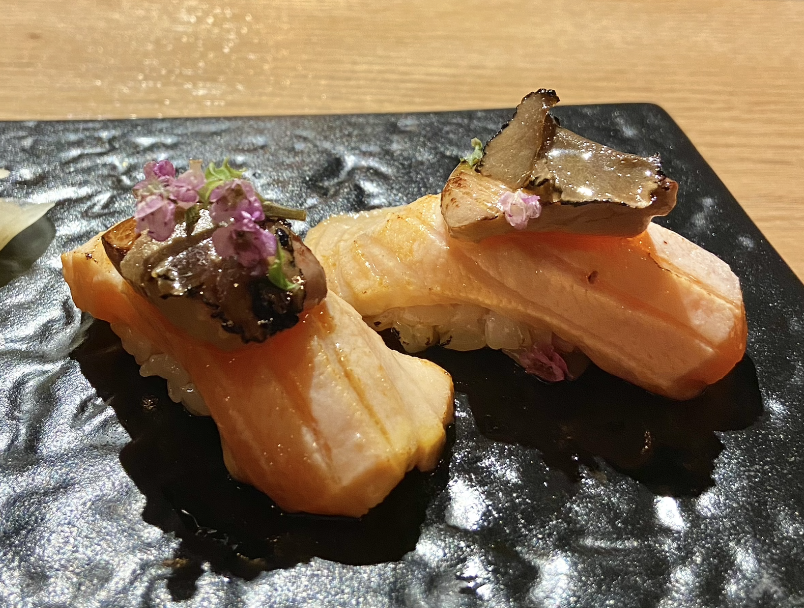
Our hotel was within the zone being barricaded/crowd-controlled for the Time’s Square ball drop, so our walk to dinner was swift, blocked only by the occasional NYPD officer asking to see our reservation to confirm that we could pass. If you’re a fan of omakase, Shinn WEST is a fantastic option in Hell’s Kitchen. Their regular menu is $69 per person and their fish portions are generous. They restrict their seatings to 55 minutes, which was perfect for us, because we needed to sprint to the Lincoln Center for our 6:30pm show. I was excited for my first opera, but was honestly worried that I’d fall asleep — when I heard ‘opera,’ I envisioned one person singing on-stage for three hours straight in a language I didn’t know. The Met’s modernized Carmen felt more like a musical, and it was easy to follow thanks to the translator strips on the back of every seat. Aigul Akhmetshina, who starred as Carmen, was incredible. I can’t believe one voice could project so clearly through an entire theater without a microphone; she stole every scene she was in.
There’s a lot I could say about New York… but we’ll leave that for next time. This is my guide to Florence, after all!




Thus, at long last, this entry concludes my guide to our 2023 Christmas trip to Italy. It was everything I could have hoped for and more. I mentioned in my guide to Rome that Italy had stolen a place in my heart back in 2016; now, I’m truly lovestruck.